The best patio or deck privacy screen is the one that fits the structure, wind exposure, desired permanence, maintenance tolerance, and local rules. Freestanding slatted panels offer immediate screening, trellises with vines soften the view over time, outdoor curtains are flexible in sheltered areas, and living shrubs can create the most natural screen where there is enough soil and space.
TL;DR: Use structural panels for fast durable privacy, plants for a living screen, trellises for narrow spaces, curtains only where wind and weather are manageable, and planters for flexible partial screening. Before attaching anything tall or solid to a deck, confirm structural capacity, wind loading, property-line restrictions, HOA rules, and permit requirements in your jurisdiction.
Compare privacy options by permanence and load
A privacy screen is not only visual. On a deck, tall panels, planters, and trellises can add weight or catch wind. A ground-level solution may not suit an elevated deck without structural review.
| Screen type | Best for | Main advantage | Main limitation |
|---|---|---|---|
| Slatted wood or composite panel | Immediate fixed privacy | Strong visual screening | Can add wind load and needs secure support |
| Trellis with vine | Narrow edges and softer screening | Uses little floor area | Needs plant selection and maintenance |
| Shrub or mixed planting | Ground-level patios and yards | Natural appearance and habitat value | Takes space and time to mature |
| Outdoor curtain | Sheltered pergolas and covered areas | Adjustable and inexpensive | Vulnerable to wind and weathering |
| Tall planters | Flexible partial screening | Movable and decorative | Heavy when filled and watered |
| Decorative metal screen | Modern fixed installations | Durable and thin | Can be costly and may need engineered support |
No option is universally “best.” Treat the table as a design comparison, not a performance ranking.
Select the right screen type
Use slatted panels when you need immediate privacy
Wood, composite, or metal slatted panels can screen sightlines immediately and can be designed to let some air through. Horizontal slats create a contemporary look, while vertical boards can echo fencing or railings. Small gaps reduce the solid-sail effect compared with a completely closed panel, but any tall screen still needs adequate support.
On a deck, do not assume the guardrail is designed to carry a privacy wall. A tall panel can create significant leverage at its attachment points during wind. Some jurisdictions explicitly regulate privacy screens on decks. For example, the City of Alameda's deck regulations address railing and privacy-screen limits, illustrating why local code review matters even though requirements differ elsewhere.
For renters or homeowners who do not want permanent attachment, freestanding panels can work on a ground-level patio if the base is engineered or weighted appropriately for local wind conditions. Do not improvise with narrow feet and tall solid sheets in exposed locations.
Choose living screens for softer boundaries
Shrubs and small trees can create privacy while adding shade, wildlife value, and seasonal interest. Select plants by mature width and height, not by their size at the garden center. Crowding a row for instant privacy can lead to pruning problems, disease pressure, or competition later.
University of Georgia Cooperative Extension notes that small trees and shrubs can be used for privacy and screening, but the suitable species depend strongly on climate and site. Use regional extension recommendations for your hardiness zone, soil, sun, moisture, and local invasive-species restrictions.
A mixed screen often looks more natural than a single-species hedge and can be more resilient if one plant develops a pest or disease problem. For habitat value, combine locally appropriate flowering shrubs and perennials rather than relying only on a dense evergreen wall.
Use trellises and vines where floor area is limited
A trellis can screen a narrow edge without consuming the depth of a full shrub border. It also gives you control over where foliage appears. The tradeoff is maintenance: vines need training and pruning, and some species can become invasive or damage nearby siding, gutters, or roof components.
Choose a vine with growth habits that suit the support. Twining vines, tendril climbers, and self-clinging vines attach differently. Avoid aggressive species that are invasive in your region or likely to overwhelm the structure.
Pruning a living screen will create recurring yard trimmings. How to make compost faster without bad smells explains how suitable clippings and dry material can be managed without turning the patio edge into a messy waste pile.
Reserve curtains and fabric screens for sheltered conditions
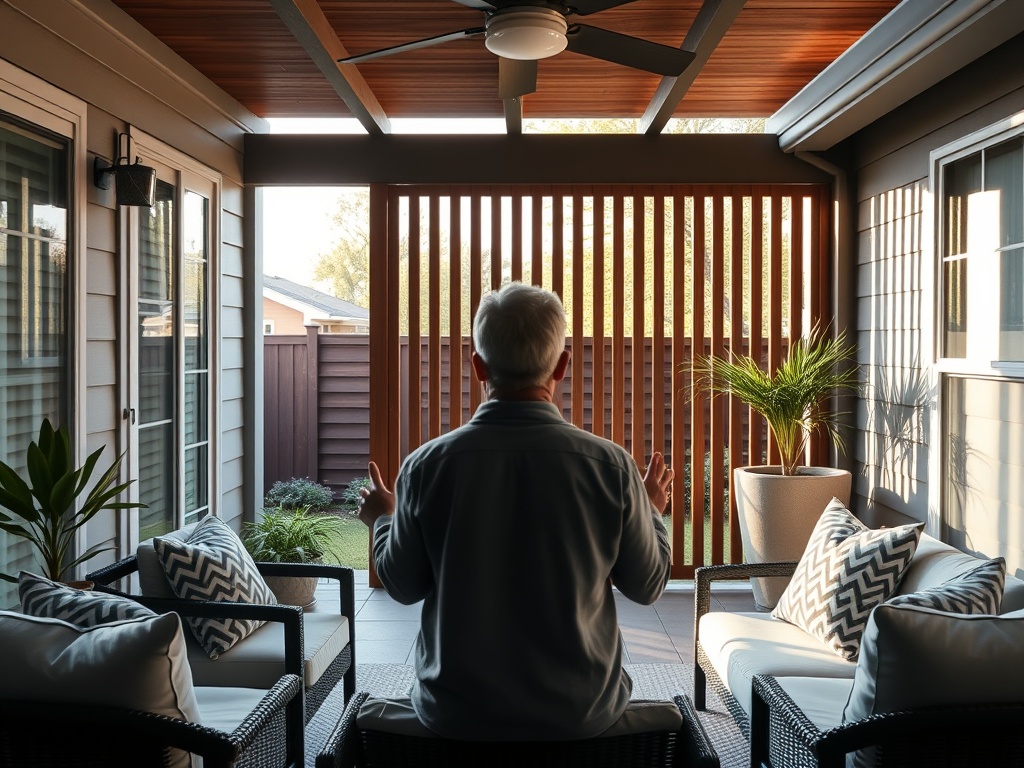
Outdoor curtains can be excellent on covered patios, pergolas, and screened structures because they open and close as needed. Use exterior-rated fabric, hardware that resists corrosion, and tiebacks that keep fabric from whipping in wind.
Do not use loose fabric near grills, heaters, fire pits, or other ignition sources. Follow clearances specified by the appliance manufacturer and local fire rules. Fabric also needs periodic cleaning and full drying before storage to limit mildew.
Retractable shade/privacy fabric can reduce visual exposure without permanently closing the space. However, large fabric panels can act like sails, so retract them during storms or high winds according to the product instructions.
Treat tall planters as both design objects and loads
Large planters can create flexible screening with ornamental grasses, bamboo alternatives, small shrubs, or trellised plants. The advantage is mobility and the ability to adjust sightlines. The disadvantage is weight. Wet potting mix, water reservoirs, ceramic containers, and mature plants can make a planter much heavier than expected.
On an elevated deck, verify that concentrated loads are appropriate before installing a row of large containers. Use stable planters with broad bases, drainage that does not damage the deck, and plants adapted to container conditions. Avoid invasive running bamboo in open soil; where bamboo-like screening is desired, consider non-invasive regional alternatives or clumping types that are appropriate locally.
Place the screen where the sightline actually occurs
A common mistake is screening the property boundary instead of the view. Check sightlines from the main seats; a shorter nearby screen may block them better than a tall screen at the lot line.
This approach can also preserve light and airflow. Partial screening around dining or lounging zones often feels less enclosed than building a continuous wall around the entire patio.
If you use a compost or utility area nearby, how to build a basic compost bin from wood pallets shows how to contain that function separately rather than asking the privacy screen to hide an unstable improvised structure.
Plan maintenance before choosing the material
Wood screens need inspection for decay, loose fasteners, and finish wear. Composite and metal reduce some maintenance but still need secure connections and cleaning. Vines need pruning, shrubs need room to mature, curtains need washing and storage, and planters need watering and drainage management.
Think about access as well. Leave enough room to stain, prune, clean, or repair the screen without dismantling furniture. Keep vegetation away from siding, vents, meters, and required equipment clearances.
Create privacy without creating a new problem
Start with the actual sightline, then choose the least complicated screen that solves it. On ground-level patios, planting and freestanding panels offer many options. On elevated decks, treat attached screens and heavy planters as structural decisions, not just decor.
Home and garden information is for educational purposes only and does not constitute professional architectural, engineering, structural, horticultural, fire-safety, electrical, or legal advice. Building, zoning, HOA, property-line, and permit requirements vary by location; verify current local rules before installation.[/