
Family resort demand is best managed as a multi-person decision problem: parents or guardians may control the budget, children can influence destination and activity choices, and different ages create different room, dining, accessibility, supervision, and scheduling needs. Operators should therefore segment family demand by party structure and trip purpose rather than treating every booking with children as one market.
Family demand decision map
Families often evaluate the total trip, not just the room. Room configuration, transparent pricing, meal convenience, age-appropriate activities, safety, accessibility, flexibility, and the ability to keep the group together can all affect value. Operators can improve performance by mapping party composition, booking lead time, school-calendar patterns, room adjacency needs, and on-property spend while avoiding assumptions about what every family wants.
Define the family unit before forecasting the family segment
A couple traveling with a toddler has different needs from two adults traveling with teenagers, a multigenerational group, or a single parent traveling with two children. Even when all four bookings are coded as family leisure, room selection, dining timing, activity use, length of stay, and price tolerance can differ sharply.
The 2025 U.S. Family Travel Survey, produced by the Family Travel Association with NYU's School of Professional Studies, reinforces the importance of hotels and resorts in family accommodation choices while also highlighting pain points such as connected-room availability and transparent pricing. The survey also discusses children's influence in trip planning. Operators can use the NYU summary of the 2025 family travel research as market context, while relying on their own booking and guest data for property decisions.
The practical segmentation layer should start with party size and ages where legitimately captured, then add room count, room adjacency request, trip length, school-holiday timing, package selection, booking window, and activity or dining purchases. Avoid inferring sensitive family characteristics from incomplete data. The goal is operational relevance, not profiling for its own sake.
A strong demand forecast also separates family trips by occasion. School-break vacations, reunions, celebrations, weddings, sports travel, theme-park trips, beach holidays, wellness stays, and multigenerational escapes can all behave differently. This matters because a resort may need different inventory and service controls even when occupancy forecasts look similar.
Treat room configuration as a revenue and satisfaction variable
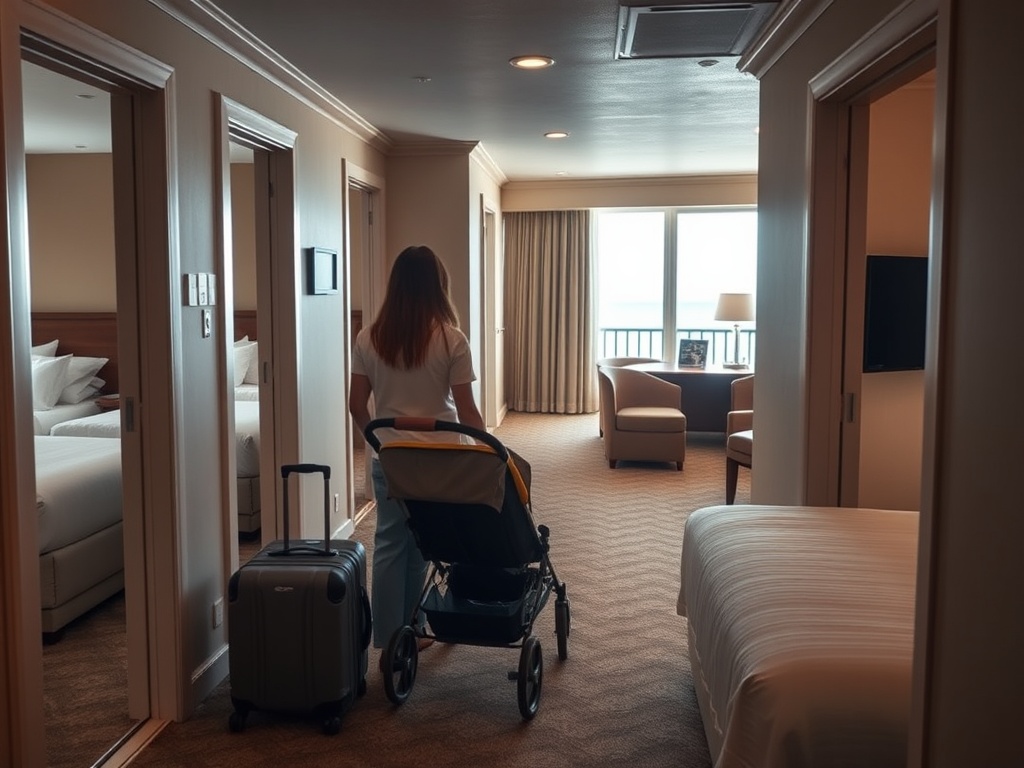
For many families, room layout is part of the core product. Connecting rooms, guaranteed adjacency, suites, sofa beds, bunk configurations, kitchenettes, cribs, and bathroom count can influence the booking choice. If the website shows these features ambiguously or cannot reliably confirm them, the resort creates both conversion friction and arrival risk.
Room configuration should therefore be managed as deliberately as view or floor level. Measure search-to-book conversion by family-relevant categories, waitlist or request frequency, upgrade acceptance, and recovery incidents tied to adjacency or bedding. If a particular configuration sells out early while nominally higher categories remain open, the hierarchy may be based on adult-centric room attributes rather than family value.
That observation connects directly to amenity packaging. A family bundle can be useful when it groups benefits that reduce practical friction, such as breakfast, selected activities, or transport. But a bundle becomes less useful when it forces guests to pay for components they will not use. Choice and clarity are more defensible than assuming every family wants the same package.
| Family demand signal | Operational implication | Commercial question |
|---|---|---|
| Repeated connected-room requests | Adjacency is part of the product promise | Can the resort sell a guaranteed configuration rather than a request? |
| High breakfast participation | Morning convenience may be strongly valued | Is breakfast best included, optional, or packaged by party size? |
| Long activity waitlists | Capacity may constrain experience quality | Should inventory be reserved by stay date or pre-arrival window? |
| Short booking windows around school breaks | Demand can compress quickly | Are minimum stays and room controls aligned with family patterns? |
| Frequent late changes | Flexibility may carry value | Can rate fences offer a clear choice between price and flexibility? |
The table should be read as a set of tests rather than conclusions. A resort with villas may find privacy more important than adjacency. An urban family hotel may see transit convenience dominate activity programming. Operators should validate the signal with guest behavior before turning it into a permanent product rule.
Design the on-property day around competing needs
Family satisfaction is often cumulative. A slow breakfast queue, unclear activity sign-up, long walk with small children, limited shaded seating, or dinner service that conflicts with children's schedules can matter more than any single headline amenity. These are operational details that affect the guest-facing value of the resort.
Map common family journeys from pre-arrival through departure. Where do guests need information? Which services require reservations? When do capacity constraints appear? Where do parents and children have conflicting preferences? A journey map can reveal that the highest-impact improvement is not a new attraction but clearer scheduling, better room readiness, more flexible dining, or more reliable transport inside the property.
The resort should also account for accessibility without assuming one standard need. The 2025 NYU/Family Travel Association summary notes concerns around inclusivity and accessibility among surveyed families. Operators should use applicable accessibility law and professional guidance for compliance, then test guest-facing processes such as accessible room information, activity descriptions, transport, and staff handoffs for clarity and consistency.
A family resort that also attracts higher-spend segments can compare these findings with its beachfront premium pricing or other attribute strategies. Families may pay more for beach proximity, but they may value shade, pools, dining access, or configuration more. Do not assume the property's most visually prestigious room is the family's highest-value room.
Make pricing legible at the total-trip level
Families often budget across several people, which makes mandatory charges, child pricing, meal-plan terms, activity fees, and cancellation rules commercially important. In the United States, the FTC's Unfair or Deceptive Fees Rule requires covered lodging sellers that display a price to show the total price upfront, including mandatory charges known and calculable in advance. The FTC short-term lodging guidance provides the compliance detail.
Beyond compliance, the operator should make age bands, occupancy rules, included meals, extra-person charges, and optional activities easy to understand. If a family has to calculate the real cost across several screens, comparison becomes harder and service contacts increase. Pricing clarity can therefore reduce both booking friction and call-center or front-desk workload.
Do not overpromise savings. A package may be convenient without being the lowest possible combination for every family. Describe what is included and who is eligible, then let the guest judge the value. That distinction protects trust and avoids presenting a subjective recommendation as fact.
Design for the whole family decision unit
Family resort demand becomes easier to manage when the property stops treating "family" as one persona. Segment by party structure and occasion, build room and service capacity around observed behavior, and make the total trip cost understandable before arrival.
For the next planning cycle, review one peak family period and trace where demand exceeded capacity: connecting rooms, breakfast, kids' activities, pools, transport, dining, or housekeeping turns. Pick the highest-friction point and measure whether a change improves conversion, guest feedback, labor efficiency, or ancillary contribution. That is a stronger family strategy than adding another generic amenity.